Heat-shrinkable cable accessories are the most widely deployed termination and joint technology for medium-voltage cable systems. They are inexpensive, field-proven, and tolerant of installer skill variability. They are also the most commonly mis-specified cable accessory — chosen by default when a cold-shrink or pre-molded silicone accessory would actually perform better. This article explains how heat-shrink terminations and joints work, where they are the right choice, and where they should be replaced by a different technology.
Quick Answer
A heat-shrink cable accessory is a coordinated insulation system, not simply a protective sleeve. Correct performance depends on matching the kit to cable construction and voltage class, controlling the electric field at the screen cut, preparing the cable precisely, applying uniform heat, and completing sealing and grounding exactly as instructed.
What “Heat Shrink” Means
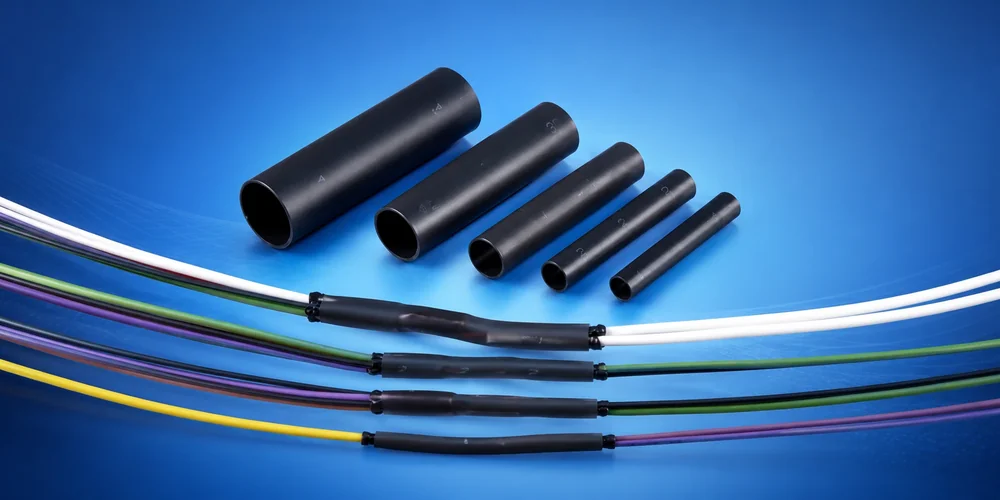
A heat-shrink tube starts as a cross-linked polyolefin (typically a blend of polyethylene and EVA, electron-beam cross-linked for memory) that has been expanded radially during manufacture and held in that expanded shape by the cross-linking. When the installer applies heat (typically 110–140 °C from a soft-flame torch or hot-air gun), the polymer’s elastic memory recovers its original smaller diameter and shrinks tightly onto the cable. After cooling, the tube grips the cable with a residual radial pressure that maintains a gas-tight seal.
The sealing function is delivered by a separate mastic liner (a butyl-based adhesive) on the inside of the tube. The mastic melts during heating, flows into surface irregularities, and re-solidifies as the tube cools. The combination of radial pressure plus mastic flow produces a moisture-proof seal that is robust under thermal cycling.
The Three Functional Layers
A heat-shrink cable accessory has three distinct layers, each addressing a different engineering requirement:
- Outer (weather / UV) layer — the black polyolefin jacket, which carries the mechanical and UV protection.
- Inner (insulating) layer — a high-dielectric-strength tube (or stack of tubes) that provides the electrical stress control.
- Stress control layer — either a geometric stress cone (a flared tube end) or a refractive stress-grading tube. The stress control layer is the most important part of the accessory because it is where 80 % of the field failures begin if the design is wrong.
A single-tube heat-shrink accessory provides only layers 1 and 2. A complete termination kit includes the stress control tube as a separate component. Always verify that the stress control is included — single-tube accessories should not be used above 6 kV class.
Where Heat-Shrink Performs Well
| Application | Heat-shrink suitability |
|---|---|
| Indoor terminations 6–35 kV | Excellent |
| Outdoor terminations 6–35 kV | Excellent |
| Straight joints 6–35 kV | Excellent |
| Transition joints (XLPE to PILC) | Good with adapter kit |
| Submersible joints (underground vault) | Excellent |
| Pole-top distribution transformers | Excellent |
| Cable to busbar connections | Excellent |
| Indoor switchgear terminations | Excellent |
In these applications, heat-shrink provides a robust, low-cost accessory with 30+ years of field history. The technology is well understood by cable jointers worldwide, and the kits are stocked by virtually every electrical distributor.
Where Heat-Shrink Should Not Be Used
| Application | Why heat-shrink is wrong |
|---|---|
| EHV cables above 35 kV class | Field installation of multi-layer stress control is too error-prone |
| Highly polluted coastal terminations | Surface tracking under salt fog — silicone cold-shrink is better |
| Fire-sensitive indoor spaces | Heat installation requires torch — use cold-shrink instead |
| Sub-freezing installations | Mastic needs ≥ 0 °C ambient to flow correctly |
| High-vibration machinery rooms | Mechanical interface can creep over time |
For EHV-class cables (110 kV and above), the modern industry standard is pre-molded silicone rubber (also called “prefab” or “push-on”) accessories. The silicone body is factory-molded under controlled conditions, and the installer simply pushes the accessory onto the prepared cable end. The electrical performance is more repeatable because no field-controlled stress grading is involved.
Installation Process
A typical heat-shrink termination installation takes 60–90 minutes for one jointer on a 15–35 kV single-core cable:
- Prepare the cable end — strip the outer jacket, semicon layer, and insulation to the dimensions called out in the kit drawing. The cuts must be square and the semicon layer must be removed cleanly without nicking the insulation.
- Apply the stress control tube — position over the semicon cutback, shrink from the cable outward. This is the most error-sensitive step.
- Apply the anti-tracking outer tube — shrink from the cable outward, overlapping the stress control tube by the specified length.
- Apply the sealing mastic — wrap the mastic at the cable jacket cutback and at the lug barrel.
- Crimp the lug — use the lug manufacturer’s recommended die and number of crimps.
- Apply the insulating breakout (3-core only) — shrink over the crotch where the three cores diverge.
- Earth the screen — install the earth braid and solder or crimp to the cable screen.
Each step has a documented visual acceptance criterion. A poor installation can usually be identified at step 2 (improper shrinkage of the stress control tube) or step 4 (insufficient mastic).
Comparison: Heat-Shrink vs Cold-Shrink vs Pre-Molded
| Feature | Heat-shrink | Cold-shrink | Pre-molded silicone |
|---|---|---|---|
| Installation skill required | Medium (torch control) | Low (pull core) | Medium-High |
| Installation tools required | Torch, crimper | None beyond prep | Crimp, no torch |
| Fire risk during install | Yes (torch) | None | None |
| Field rework | Possible with new kit | Requires new kit | Requires new kit |
| Cost (15 kV termination) | Lowest | Medium | Highest |
| Field life | 25–30 years | 25–30 years | 30+ years |
| Suitability for EHV | Limited | Limited | Standard |
For most 6–35 kV cable work, heat-shrink remains the most economical choice. Cold-shrink has displaced heat-shrink only in fire-sensitive indoor installations (tunnels, high-rise buildings, hospitals). Pre-molded silicone is standard above 35 kV and is increasingly used below 35 kV for critical circuits.
Common Mistakes in Heat-Shrink Selection
- Buying a single-tube kit for a 15 kV or higher system. Single-tube kits provide only weather sealing, not stress control. They should not be used above 6 kV.
- Specifying a kit for the wrong cable type. XLPE, EPR and PILC cables have different geometries and different accessory requirements. A kit for XLPE cannot be used on PILC without an adapter.
- Ordering indoor-only kits for outdoor service. Outdoor kits include anti-tracking outer tubes; indoor kits do not.
- Ignoring altitude correction. Above 1000 m, the air density is lower and clearances must be increased. Some kit ratings are de-rated accordingly.
Frequently Asked Questions
Can one kit be used for every cable of the same voltage class?
No. Confirm conductor size, insulation diameter, screen type, armor, number of cores, lug geometry, and indoor or outdoor duty against the kit’s application range.
What causes most installation failures?
Common causes include damaged insulation, incorrect screen-cut dimensions, contamination, trapped moisture, overheated tubing, incomplete shrink recovery, poor stress-control placement, and inadequate sealing.
When should cold-shrink or premolded accessories be considered?
Consider alternatives where open-flame or hot-work controls are restrictive, installation space is limited, environmental conditions are difficult, or the utility standard specifies a different accessory technology.
Conclusion
Heat-shrink cable accessories are the right choice for 6–35 kV terminations and joints in clean-to-moderately polluted environments, both indoor and outdoor. They are inexpensive, widely available, and well understood by installation crews.
For a 10–35 kV medium-voltage cable accessory kit — including stress control tubes, anti-tracking outer tubes, sealing mastic, and crimp lug — Starlight Electric supplies a complete heat-shrinkable cable termination family tested to IEC and IEEE standards.
Browse the heat-shrinkable cable termination kit range at st-trafo.com, or send your cable specification (size, voltage class, conductor material, screen type) to the engineering team for a kit recommendation.
Related Reading
- Deadbreak vs Loadbreak Bushing Interfaces: When to Use Each
- Separable Connector Systems: Type A, Type B, Type C Interface Comparison
—
Specifying cable accessories for a transition between cable types (XLPE to PILC) or for an unusual environment? Send the cable datasheet and installation conditions to Starlight for a written accessory package.
Browse Related Products
The following Starlight Electric components are referenced throughout this guide and available with full factory test reports: