A transformer bushing is a critical interface on a distribution-class transformer. Selecting the wrong bushing produces poor contact, oil leaks, partial discharge, or a thermal failure long before the transformer reaches end-of-life. This guide walks through the four practical decisions that drive a bushing selection: voltage class, continuous current, BIL (Basic Impulse Level), and terminal configuration. It is written for procurement engineers, transformer assemblers and field-service technicians who need a defensible specification before they place an order.
Quick Answer
A correct transformer bushing matches six items: the applicable standard, highest system voltage, insulation level, continuous current, mounting interface, and terminal arrangement. Also confirm pollution severity, altitude, ambient temperature, oil and gasket compatibility, and the required test documentation before ordering.
Why Bushing Selection Matters More Than Other Transformer Accessories
Bushings do three things at once: they carry continuous load current, they withstand lightning and switching impulse voltages, and they seal the tank against oil leakage. Each requirement is engineered separately and then combined into a single part. A bushing that is correct for one parameter but wrong for another will fail in service — often during the first switching event in a thunderstorm.
The economic impact can be significant because field replacement may require an outage, controlled liquid handling, tank work, new seals, and electrical testing. Correct selection before installation reduces rework and outage risk.
The Four Selection Parameters
1. Voltage Class (kV)
Voltage class defines the steady-state AC stress the bushing insulation must withstand. For distribution transformers, the practical voltage classes are:
| Voltage class | Typical service | Common standard |
|---|---|---|
| 1.2 kV | LV secondary on pad-mount transformers | ANSI |
| 5 kV | LV secondary on substation transformers | ANSI |
| 8.7 kV | Older US distribution standards | ANSI |
| 15 kV | Class A distribution | ANSI / IEC |
| 25 kV | Class B distribution (25 kV grounded wye) | ANSI / IEC |
| 34.5 kV (35 kV) | Class C distribution, substation feeders | ANSI / IEC |
Voltage class is not the same as BIL. A 15 kV class bushing must withstand a 95 kV BIL, while a 34.5 kV class bushing must withstand 150 kV BIL. This is the most common specification mistake — buyers ordering “15 kV bushings” without specifying the BIL sometimes receive a class-A bushing with insufficient impulse margin for a high-impedance system.
2. Continuous Current (A)
The continuous current rating is the steady-state load current the bushing contact is designed to carry without exceeding its temperature rise limit (typically 65 °C above ambient in oil-immersed service). Common ANSI ratings are:
| Current rating | Typical use |
|---|---|
| 55 A | Small distribution transformers, CT secondary bushings |
| 125 A | Residential pad-mount secondary |
| 200 A | Single-phase service lateral |
| 250 A | Three-phase residential |
| 400 A | Light commercial pad-mount |
| 600 A | Commercial / industrial pad-mount |
| 800 A | Substation secondary |
| 1200 A | Substation secondary, large pad-mount |
| 2000 A | Large substation, network transformer |
| 3150 A | Network or power transformer secondary |
Do not apply a universal overload factor to every bushing. Coordinate the bushing rating with the transformer’s loading guide, top-oil and ambient temperatures, conductor and terminal limits, enclosure conditions, and the bushing manufacturer’s documented overload capability.
3. BIL (Basic Impulse Level)
BIL is the 1.2 / 50 µs lightning impulse voltage the bushing must withstand three times in each polarity without flashover or puncture. It is not optional and not negotiable — it is set by the system insulation coordination study.
| Voltage class | Standard BIL (kV) |
|---|---|
| 1.2 kV | 30 kV |
| 5 kV | 60 kV |
| 15 kV | 95 kV |
| 25 kV | 125 kV |
| 34.5 kV | 150 kV |
A reduced BIL (lower than the standard value) is sometimes specified for solidly grounded systems. If your system study calls for reduced BIL, confirm that the bushing supplier can match the lower value without re-engineering.
4. Terminal Configuration
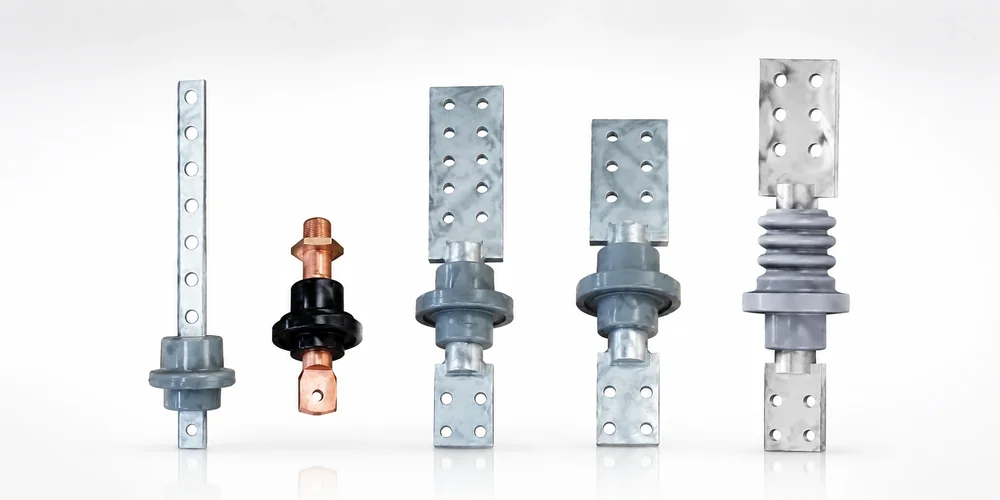
The terminal is the bolted or crimped lug at the top of the bushing. Five common configurations are used in ANSI distribution transformers:
| Terminal | Current range | Tooling |
|---|---|---|
| Solid rod (stud) | 55 A | Setscrew or crimp |
| 1-hole spade | 125–250 A | 1 bolt, typically NEMA 4-hole pattern at smaller scale |
| 2-hole spade | 250–600 A | NEMA 2-hole pattern |
| 4-hole spade | 600–1200 A | NEMA 4-hole pattern |
| 6-hole or 8-hole pad | 1200–3150 A | NEMA multi-hole pattern |
The NEMA pad pattern is the standard geometry; matching it ensures your existing cables and lugs fit without modification.
Working Example: Selecting a Bushing for a 500 kVA Pad-Mount
A typical 500 kVA pad-mount transformer has these secondary requirements:
- 120/240 V single-phase or 208/120 V three-phase
- Full-load secondary current around 1500–1700 A
- Available fault current around 10 kA
- 95 kV BIL on the primary side, 30 kV BIL on the secondary
For the secondary bushings, the appropriate ANSI rating is:
- Voltage class: 1.2 kV
- BIL: 30 kV
- Current: calculate from the actual secondary voltage and phase configuration; for example, 500 kVA at 208 V three-phase is about 1,388 A, while 500 kVA at 240 V single-phase is about 2,083 A
- Terminal: 4-hole NEMA pad to accept standard 4-hole lugs
The required bushing therefore depends on the secondary connection. A 208 V three-phase design needs a continuous-current rating above 1,388 A after applying the transformer’s loading and temperature criteria; a 240 V single-phase design requires more than 2,083 A. Confirm the terminal arrangement and tank interface before choosing a catalog family.
Field-Proven Selection Tips
- Always derate for ambient. If the transformer is in a vault at 40 °C ambient, derate current by 10 %.
- Match the insulation level to the system study and governing specification. Do not infer the required impulse withstand from nominal voltage alone.
- Confirm the cover hole pattern before ordering. A bushing with the wrong mounting flange cannot be retrofitted — it requires tank modification.
- Verify oil compatibility. EPDM-rubber gaskets are standard, but some older transformer tanks use cork-rubber. Mismatched gaskets leak under thermal cycling.
- Plan for the spare. For a fleet of pad-mounts, stock at least two spare bushings per voltage class. Bushing failures are not predictable, and a spare turns a four-week wait into a same-day repair.
Frequently Asked Questions
Is voltage class enough to select a transformer bushing?
No. Voltage class is only the starting point. The insulation level, current rating, mounting dimensions, terminal pattern, service environment, and governing standard must also match.
Can a higher-current bushing replace a lower-current model?
Only when the mounting interface, conductor size, terminal geometry, clearances, insulation level, and transformer design all remain compatible. A higher current rating does not guarantee a drop-in fit.
What information should I send for a replacement recommendation?
Provide clear nameplate photos, transformer voltage and kVA, system grounding, required insulation level, continuous current, tank-hole and stud dimensions, terminal pattern, site altitude, pollution conditions, and applicable standard.
Where to Source
For ANSI distribution-class transformer bushings from 1.2 kV to 34.5 kV — covering current ratings from 55 A to 3150 A and rod, 1-hole, 2-hole, 4-hole and multi-hole terminal configurations — Starlight Electric offers a complete family of epoxy-molded and porcelain-housed bushings. Request the applicable routine-test report, drawings, and a clear statement of the standard and edition used for the offered bushing.
Browse the full ANSI bushing family at st-trafo.com, or contact the engineering team for a project-specific selection.
Related Reading
- ANSI vs IEC Standards for Transformer Bushings: What International Buyers Need to Know
- How to Read a Transformer Bushing Nameplate: Voltage, Current, BIL, and Standards Explained
—
Need help matching a bushing to a specific transformer nameplate? Send your transformer rating, system BIL, and short-circuit current to the Starlight engineering team for a written selection within one business day.
Browse Related Products
The following Starlight Electric components are referenced throughout this guide and available with full factory test reports:
- ANSI 1.2kV 125A–250A Transformer Bushings
- ANSI 1.2kV 417A–1200A Transformer Bushings
- ANSI 5kV 630A–4000A Transformer Bushings
- ANSI 10kV 800A–2000A Transformer Bushings
- ANSI 15–34kV 55A Rod Terminal Transformer Bushings