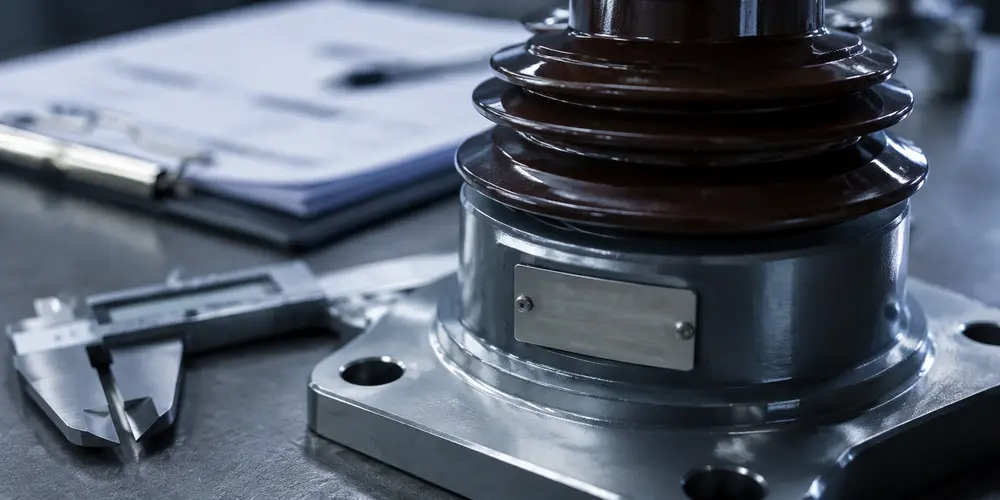
A transformer bushing nameplate is a small metal plate — usually riveted to the flange of the bushing — that encodes all the ratings the field technician needs to verify a replacement. Despite being only 50 mm × 80 mm in size, the nameplate typically contains ten or more separate data fields. Misreading any one of them can result in a bushing that fits mechanically but fails electrically. This article decodes each field and shows how to use the data to verify a replacement specification.
Quick Answer
A nameplate is essential but may not contain every item needed for replacement. Record the manufacturer, type and serial number, rated voltage or Um, current, insulation level, capacitance and power factor where applicable, standard, year, and mass; then verify drawings, terminal and mounting dimensions, oil-end length, clearances, CT requirements, service conditions, and test documentation.
What the Nameplate Looks Like
A typical ANSI / IEEE C57.19.01 bushing nameplate looks like this:
┌────────────────────────────────────┐
│ MANUFACTURER   TYPE DESIGNATION    │
│ YEAR    SERIAL No.                 │
│ ────────────────────────────────── │
│ VOLTAGE CLASS:  15 kV              │
│ BIL:             95 kV             │
│ CURRENT:         200 A             │
│ FREQUENCY:       60 Hz             │
│ POWER-FREQ WITHSTAND:  35 kV / 1m  │
│ ────────────────────────────────── │
│ STANDARDS: IEEE C57.19.00 / IEC 60137 │
│ OIL TEMP RISE: 65 K ABOVE AMBIENT  │
│ PD LIMIT:       10 pC at 1.5×Ur/√3 │
│ ────────────────────────────────── │
│ TORQUE LUG:    50 N·m              │
│ MOUNTING:      NEMA 4-HOLE         │
│ MASS:          4.5 kg              │
└────────────────────────────────────┘
The exact layout varies by manufacturer, but the fields are standardized by IEEE C57.19.01 §6.4 (ANSI) and IEC 60137 §6.
Field-by-Field Decode
Manufacturer
The bushing manufacturer’s name and logo. For multi-source procurement, the manufacturer field is the first piece of data you check to ensure you are getting the same product you qualified.
Type Designation
A manufacturer-specific alphanumeric code that uniquely identifies the bushing product. For example:
- ABB uses type designations like
O Plus CorMAGNOVA - GE uses designations like
Type LorType OCB - Starlight uses designations like
SLT-OF-15-200-A
When verifying a replacement, always cross-reference the type designation against the original purchase order. Two type designations from the same manufacturer may look similar but have different terminal configurations.
Year of Manufacture
A four-digit year. For a fleet of bushings, this field drives the warranty and the field-aging analysis. A bushing manufactured in 2018 has a different expected remaining life than one manufactured in 2024, even if they are the same type designation.
Serial Number
A unique identifier for the individual bushing. The serial number is the link between the nameplate and the factory test report. When a failure occurs in service, the serial number is the first field the manufacturer asks for.
Voltage Class
The system voltage class, not the maximum test voltage. For a bushing rated 15 kV, the actual maximum system voltage it is designed for is typically 15 kV as the nominal line-to-line voltage. The maximum voltage the bushing can continuously withstand is 1.05–1.1 times the class voltage.
| Nameplate voltage class | Typical use |
|---|---|
| 1.2 kV | LV secondary on pad-mount |
| 5 kV | LV secondary on substation |
| 15 kV | Class A distribution |
| 25 kV | Class B distribution |
| 34.5 kV | Class C distribution |
| 46 kV | Distribution substation |
| 69 kV | Transmission substation |
| 115 kV | Transmission substation |
| 138 kV | Transmission substation |
BIL (Basic Impulse Level)
The lightning impulse withstand voltage, expressed as a peak 1.2 / 50 µs value. The bushing must withstand three positive and three negative impulses at this voltage without flashover or puncture.
| Nameplate voltage class | Standard BIL |
|---|---|
| 1.2 kV | 30 kV |
| 5 kV | 60 kV |
| 15 kV | 95 kV |
| 25 kV | 125 kV |
| 34.5 kV | 150 kV |
A reduced BIL is sometimes specified for solidly grounded systems. The nameplate will show the reduced value, not the standard value, so a 15 kV bushing with a 75 kV BIL is a valid product for a specific application but is not a universal replacement.
Current Rating
The continuous current the bushing contact is designed to carry in oil at the standard ambient (30 °C average, 40 °C peak). Common ratings:
| Rating | Typical use |
|---|---|
| 55 A | CT secondary |
| 200 A | Single-phase service |
| 400 A | Three-phase residential |
| 800 A | Substation secondary |
| 1200 A | Large substation |
| 2000 A | Network transformer |
| 3150 A | Power transformer |
Frequency
The power-system frequency. Most modern bushings are rated 50/60 Hz, which means they can be used on either 50 Hz or 60 Hz systems without de-rating. Older bushings (pre-1980) may be rated for 60 Hz only.
Power-Frequency Withstand
The one-minute power-frequency voltage the bushing is designed to withstand. For a 15 kV class bushing, the typical value is 35 kV / 1 min. This test is performed at the factory as a routine test on every bushing.
Standards
The standards to which the bushing is designed and tested. A dual-rated bushing will show both ANSI / IEEE and IEC standards:
IEEE C57.19.00(general requirements)IEEE C57.19.01(distribution bushings)IEEE C57.19.04(high-voltage power transformer bushings)IEC 60137(insulated bushings for AC voltages above 1000 V)
For procurement, always verify the standards compliance matches the requirement. A bushing rated only to IEEE C57.19.01 may not satisfy an IEC 60137 specification for a European utility.
Oil Temperature Rise
The maximum permissible temperature rise of the bushing contact above the ambient oil temperature. The standard value is 65 K (or 65 °C above the 30 °C average ambient, yielding a 95 °C absolute contact temperature). Some bushings are rated for 55 K rise for use in ester fluids or silicone oil.
Partial Discharge (PD) Limit
The maximum permissible partial discharge level, expressed in picocoulombs (pC), at a specified multiple of the rated voltage. For a 15 kV class bushing:
- ANSI limit: 10 pC at 1.5 × Ur / √3 (= 13 kV)
- IEC limit: 10 pC at 1.1 × Ur / √3 (= 9.5 kV)
A bushing with a nameplate PD limit of 10 pC satisfies both ANSI and IEC acceptance criteria. A bushing with a nameplate PD limit of 5 pC is a higher-quality product and is preferred for critical applications.
Torque for Lug
The maximum torque to apply to the contact bolt when terminating a cable lug. Typical values are 30–80 N·m depending on the bolt size. Exceeding this torque will damage the contact. Under-torquing will cause hot spots in service.
Mounting Pattern
The bolt circle and bolt-hole pattern on the bushing flange. For ANSI distribution bushings, the standard patterns are:
- NEMA 2-hole — small distribution
- NEMA 4-hole — most distribution pad-mounts
- Porcelain multi-bolt — older substation designs
A replacement bushing must match the bolt circle diameter and bolt-hole pattern of the original. Mismatched mounting patterns require tank modification.
Mass
The shipping mass of the bushing. Useful for handling planning and for verifying the bushing is suitable for the lifting equipment available at the installation site.
Using the Nameplate to Verify a Replacement
When replacing a bushing in the field, follow this sequence:
- Record the nameplate data of the failed bushing (manufacturer, type, serial, year, voltage, BIL, current, standards).
- Cross-reference the type designation against the original purchase order and the transformer test report.
- Match the mounting pattern — physically compare the failed bushing flange to the candidate replacement.
- Verify the standards compliance matches the procurement specification for the system.
- Compare the oil temperature rise rating — using a 55 K rise bushing in a transformer that expects 65 K rise will produce higher operating temperatures.
- Check the partial discharge limit — for critical applications, a 5 pC bushing is preferred over a 10 pC bushing.
- Order by type designation and serial — the manufacturer’s order system requires the type designation, not just the rating fields.
If the failed bushing nameplate is illegible, do not guess. Remove the bushing from the tank and have the manufacturer identify it from the physical dimensions and the connector geometry.
Common Field Errors
- Matching voltage class but not BIL. A 15 kV / 95 kV BIL bushing is not interchangeable with a 15 kV / 110 kV BIL bushing.
- Matching current but not terminal type. A 200 A bushing with a 1-hole spade is not interchangeable with a 200 A bushing with a 4-hole pad.
- Assuming “NEMA standard” means identical. NEMA pad patterns have multiple variants; verify the bolt circle diameter.
- Ignoring the standards marking. A bushing marked only to IEEE may not satisfy an IEC procurement requirement.
- Failing to record the serial number. Without the serial number, the manufacturer cannot retrieve the original test report.
Frequently Asked Questions
Can I order a replacement from a nameplate photo alone?
Sometimes a manufacturer can identify the exact catalog item, but a safe replacement check normally also needs dimensional drawings, transformer data, service conditions, and the required standard.
What if the BIL is not shown?
Use the manufacturer record, transformer documentation, or applicable specification. Do not infer the required insulation level solely from nominal system voltage.
Why should capacitance and power factor be recorded?
For capacitance-graded bushings, baseline values support commissioning and condition assessment. Compare measurements using the manufacturer’s instructions and appropriate temperature corrections.
Conclusion
A transformer bushing nameplate is a compact but complete specification document. Reading it correctly is the first step in any field replacement, and verifying each field against the original specification is the only way to ensure the replacement bushing is functionally equivalent to the failed unit.
Starlight Electric bushing nameplates include all IEEE C57.19.01 and IEC 60137 required fields, with dual-rating markings where applicable. Each bushing ships with a nameplate riveted to the flange and a separate factory test report that cross-references the serial number.
Browse the bushing nameplate and factory test report example at st-trafo.com, or send a photograph of a failed bushing nameplate to the engineering team for a replacement cross-reference.
Related Reading
- Transformer Bushing Selection: A Complete Guide to Voltage Class, Current Rating, and Terminal Type
- ANSI vs IEC Standards for Transformer Bushings: What International Buyers Need to Know
—
Need help identifying an unmarked or weathered bushing for replacement? Send a photograph of the bushing and the transformer nameplate to Starlight for a cross-reference identification and replacement quote.
Browse Related Products
The following Starlight Electric components are referenced throughout this guide and available with full factory test reports:
- ANSI 1.2kV 125A–250A Transformer Bushings
- ANSI 1.2kV 417A–1200A Transformer Bushings
- 630A 24kV Interface C Equipment Bushing